Daylight Saving Time Ends

United States
United States

Quick Facts

HashtagsCompiled on#DaylightSavingTime, #DaylightSavings
Related Hashtags#FallBack
2026 DateNovember 1, 2026

Daylight Saving Time Ends

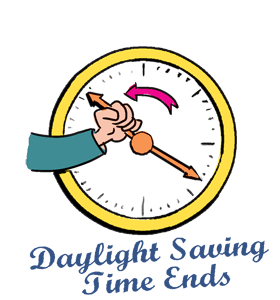
A clock’s pink hand moves backward as a hand adjusts it, marking the end of daylight saving time.
Daylight Saving Time Ends in

Daylight Saving Time Ends History

Daylight Saving Time Ends, commonly known as "fall back," is the annual practice of moving clocks one hour backward in order to allow for more daylight in the evening during the warmer months. This change effectively shifts the hours of daylight to better align with the hours when most people are awake and active, providing additional daylight for work, leisure, and energy conservation. The primary purpose of this time shift is to make better use of daylight and reduce energy consumption, as well as to decrease the number of traffic accidents and crime rates.

The concept of Daylight Saving Time was first proposed by Benjamin Franklin in 1784 but was not widely adopted until World War I when Germany implemented the practice to conserve fuel. Since then, numerous countries have adopted, adjusted, and abandoned the time change based on local needs and preferences. In the United States, Daylight Saving Time was standardized by the Uniform Time Act of 1966, which established the specific dates for the beginning and end of the time change. However, individual states and territories are not required to observe the change, and Arizona and Hawaii currently do not implement Daylight Saving Time.

Daylight Saving Time ends in the United States on the first Sunday in November, marking the return to Standard Time. At this time, clocks are turned back one hour, effectively increasing the number of morning daylight hours while resulting in earlier sunsets in the evening.

Top 10 Facts for Daylight Saving Time Ends in 2026

  • The 2026 conclusion of Daylight Saving Time marks another instance where most of the United States synchronizes the shift back to Standard Time, a practice governed by the Uniform Time Act of 1966.
  • Public discourse surrounding this transition often highlights the 'Sunshine Protection Act,' a recurring legislative proposal that seeks to make Daylight Saving Time permanent, though it has yet to be enacted into federal law.
  • When the clocks 'fall back,' many regions experience an immediate shift in natural light, resulting in earlier sunsets that significantly alter evening commuting patterns and energy consumption habits.
  • Sleep experts and medical organizations frequently use this seasonal transition as a reminder to prioritize sleep hygiene, as the sudden change in time perception can temporarily disrupt circadian rhythms.
  • Many fire departments and safety agencies utilize this weekend as a consistent public service reminder for households to replace the batteries in smoke detectors and carbon monoxide alarms.
  • The phenomenon of 'spring forward, fall back' does not apply uniformly across the country, as Hawaii and most of Arizona observe Standard Time year-round and do not participate in the time change.
  • While the United States observes this transition, much of the world follows different schedules, often leading to temporary discrepancies in time zone offsets between the U.S. and international trading partners.
  • The historical roots of this practice are often linked to energy conservation efforts during World War I and World War II, though modern studies on the actual energy-saving impact of the shift remain a subject of academic debate.
  • Literature and pop culture have long used the concept of shifting time as a thematic element, such as in the classic novel The Time Machine by H.G. Wells, which explores the human fascination with manipulating and perceiving the passage of time.
  • Despite the common phrase 'fall back,' the actual transition happens at 2:00 a.m. local time, meaning the shift is technically occurring in the early hours of a Sunday morning to minimize disruption to commerce and transportation.

Top things to do for the end of daylight saving

  • Replace the batteries on smoke and carbon dioxide detectors.
  • Put the emergency winter kit back in the vehicle.
  • Begin preparing for the coming holidays.
  • Make sure outdoor lights are in working order.
  • Put reflectors on bikes so that vehicles can more easily see you as it gets dark earlier.
‹
›

Copyright 2002-2026 © Sapro Systems LLC • About • Privacy Policy • License Terms • Corrections & Suggestions •